Volkswind has been passionately developing, financing and realising wind farms throughout Europe for 30 years. From the initial idea to commissioning, we take on all tasks in the process chain.
Together with our partners, we make the energy transition possible. In doing so, we rely on a long-standing, trusting cooperation with land owners, municipalities and business partners.
Volkswind has been passionately developing, financing and realising wind farms throughout Europe for 30 years. From the initial idea to commissioning, we take on all tasks in the process chain.
Together with our partners, we make the energy transition possible. In doing so, we rely on a long-standing, trusting cooperation with land owners, municipalities and business partners.
Same location – more power: How repowering accelerates the energy transition
Fewer turbines, more output, higher yield: The repowering of wind turbines opens up new perspectives for the expansion of wind energy. Modern technology makes it possible to generate many times more electricity at proven locations without taking up additional space. This approach is becoming increasingly important in order to accelerate the energy transition and further strengthen wind power as a supporting pillar of energy supply in Europe.
What does repowering mean?
The term repowering literally means “power plant renewal” and describes the targeted modernization of existing energy plants. In wind energy, older wind turbines are dismantled and replaced by a smaller number of modern, more powerful turbines, while the location and infrastructure are retained. The new generation of turbines works much more efficiently and makes it possible to generate more electricity on the same area than before. The installation of modern wind turbines brings numerous advantages, from higher electricity yields to improved immission and species protection to more efficient land use.
Size and Performance: The Evolution of Plant Engineering
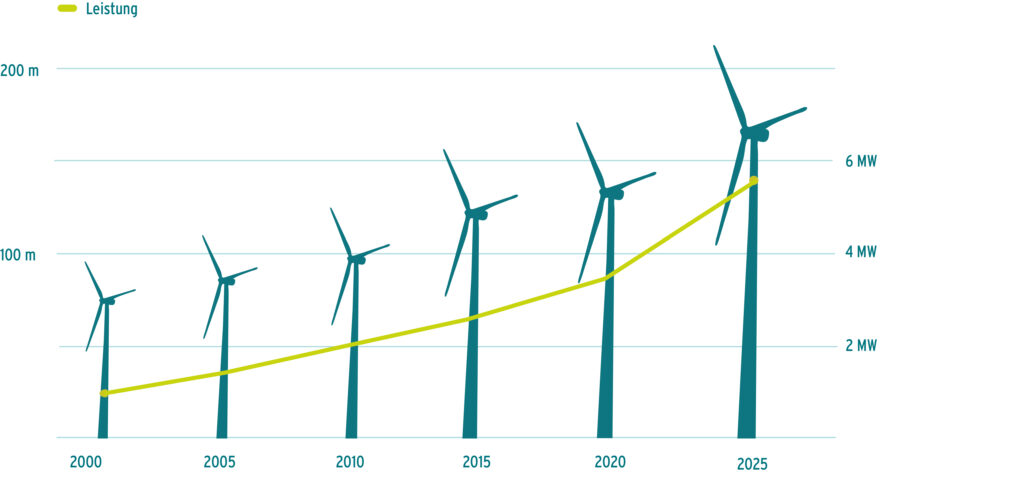
Plant technology has made an impressive leap forward in development in recent decades. While wind turbines in the mid-1980s still had a hub height of around 40 metres and a rotor diameter of around 30 metres, average new turbines today achieve a hub height of 146 metres with a rotor diameter of 151 metres.
These dimensions pay off: with every additional metre of height, the electricity yield increases by around one percent. The rotor size has an even more significant effect: if the blade length is doubled, the yield quadruples. Since the wind blows more evenly and stronger at higher altitudes, modern turbines can also make optimal use of their performance.
The output of the turbines has also multiplied in recent years: While in 2000 it was still an average of 1 MW per turbine, today turbines with around 5 MW and more are installed. The higher full-load hours and the more efficient use of the wind supply significantly reduce generation costs. Wind energy is already one of the cheapest forms of electricity generation. This is especially true for onshore wind energy at good locations.
Optimized park layout: Fewer plants, more yield
The number of wind turbines in a wind farm is reduced when repowering is carried out. A rule of thumb for repowering projects illustrates the potential: If the number of turbines is halved, the output can be doubled and the electricity yield tripled. The available space is used more effectively, and in total fewer plants are needed.
Older wind turbines are often scattered and near buildings. Repowering thus also offers the opportunity to rearrange the turbines in terms of spatial planning and thus relieve the burden on the landscape.
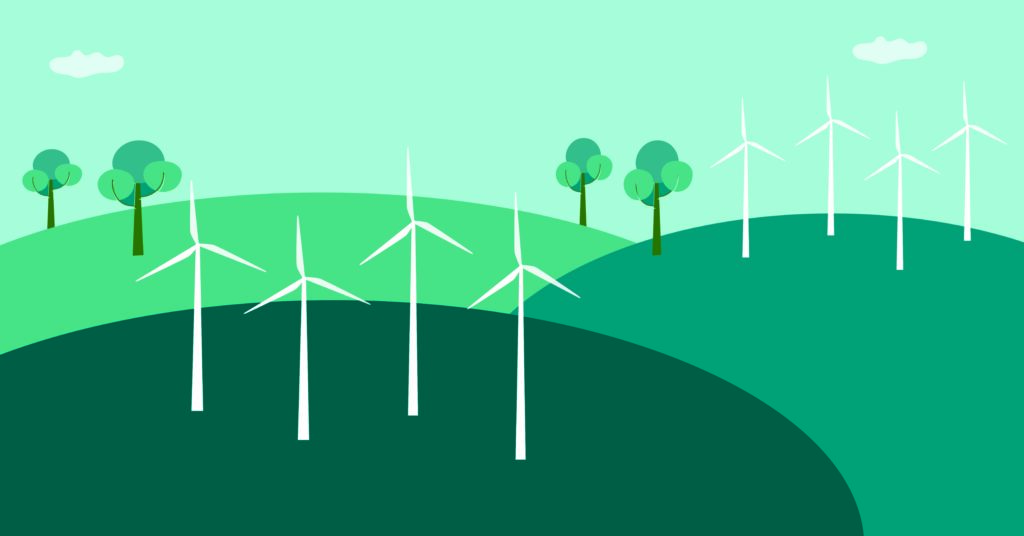
Less is more: four modern wind turbines at 3 MW each replace eight older turbines at 1.5 MW and deliver three times as much electricity—an example of the vast potential of repowering.
Home advantage: cost advantages and accelerated implementation
Repowering projects benefit from the existing local acceptance of wind energy at established locations. The existing infrastructure, such as substations, cable trays, access roads, can continue to be used. This saves costs and resources, as the necessary construction measures are significantly lower.
Another advantage: The sites are already designated for wind power. Lengthy approval procedures and comprehensive environmental assessments are largely eliminated. This makes repowering a faster process that accelerates the energy transition.
More powerful, quieter, more compatible
Modern wind turbines are much quieter than their predecessors. As the rotor diameter increases, the maximum speed decreases; this makes the systems run more smoothly. In addition, there are optimised wing aerodynamics, which further reduce noise. The demand-controlled night marking in modern systems also prevents continuous flashing at night.
Since modernised wind farms are built according to current regulations, new plans correspond to the latest state of immission control law. In this way, any planning errors from the past can be corrected.
Better grid integration and system stability
Technically state-of-the-art systems can be integrated much better into the electrical grid. Modern wind turbines can provide system services such as reactive power and balancing power, are controllable and contribute to grid stabilization. This is an important contribution to the security of supply in the future.
More added value for municipalities
Municipalities benefit from higher revenues in repowering, which go hand in hand with the increased yield volumes. These include payments under Section 6 of the Renewable Energy Sources Act (EEG) as well as trade tax revenues. The municipality where a wind farm is located is legally awarded at least 70 percent of the trade tax revenue.
Dismantling and recycling: Responsible handling of old plants
In repowering, the old turbines are completely dismantled; the concrete foundation will also be completely removed from the ground. After dismantling, equipment can in some cases be resold as a whole or serve as a spare parts warehouse. In this case, individual components such as rotor blades, gearboxes or generators find a new use.
What cannot be resold is professionally recycled: Around 90 percent of a wind turbine – including the tower, metal-containing components, electrics and foundations – can be recycled during dismantling and returned to the economic cycle as secondary raw materials.
The segments of steel and concrete hybrid towers are usually dismantled gradually. Towers and foundations can be easily recycled: the concrete is crushed on site and then used in road construction, while the steel from the nacelle and tower segments is recycled in steel production.
A lot has also happened in recent years in the recycling of rotor blades. Today, fiber-reinforced plastics are mainly used in the cement industry: The synthetic resins provide energy for the energy-intensive firing process, while the glass fiber components replace natural raw materials such as sand. This process helps to save fossil fuels and primary raw materials. At the same time, the wind industry is working intensively on new, more recycling-friendly materials and processes to further improve the recyclability of rotor blades in the future.
Volkswind also relies on repowering
Volkswind is also taking advantage of the high potential that results from repowering. In Harlingerode, Lower Saxony, for example, two wind turbines from 2001 were completely dismantled in 2025, including the foundations. Over their operating life, the two plants, each with a capacity of 1.5 MW, supplied electricity to around 900 average German four-person households year after year, purely in mathematical terms. In its place, a modern wind turbine is now being built that can generate three times as much electricity while halving the number of turbines at the same time. The project impressively shows how proven locations can be made fit for the future with modern technology.
Conclusion
Repowering is more than just replacing old turbines with new ones. It is a smart approach to using wind energy more efficiently and accelerating the energy transition. Proven locations, modern technology and responsible use of resources make repowering a key to a sustainable energy future.
To provide the best experiences, we use technologies like cookies to store and/or access device information. Consenting to these technologies will allow us to process data such as browsing behavior or unique IDs on this site. Not consenting or withdrawing consent, may adversely affect certain features and functions.
Fonctionnal
Always active
The technical storage or access is strictly necessary for the legitimate purpose of enabling the use of a specific service explicitly requested by the subscriber or user, or for the sole purpose of carrying out the transmission of a communication over an electronic communications network.
Préférences
L’accès ou le stockage technique est nécessaire dans la finalité d’intérêt légitime de stocker des préférences qui ne sont pas demandées par l’abonné ou l’internaute.
Statistics
The technical storage or access that is used exclusively for anonymous statistical purposes. Without a subpoena, voluntary compliance on the part of your Internet Service Provider, or additional records from a third party, information stored or retrieved for this purpose alone cannot usually be used to identify you.Le stockage ou l’accès technique qui est utilisé exclusivement dans des finalités statistiques anonymes. En l’absence d’une assignation à comparaître, d’une conformité volontaire de la part de votre fournisseur d’accès à internet ou d’enregistrements supplémentaires provenant d’une tierce partie, les informations stockées ou extraites à cette seule fin ne peuvent généralement pas être utilisées pour vous identifier.
Marketing
The technical storage or access is required to create user profiles to send advertising, or to track the user on a website or across several websites for similar marketing purposes.